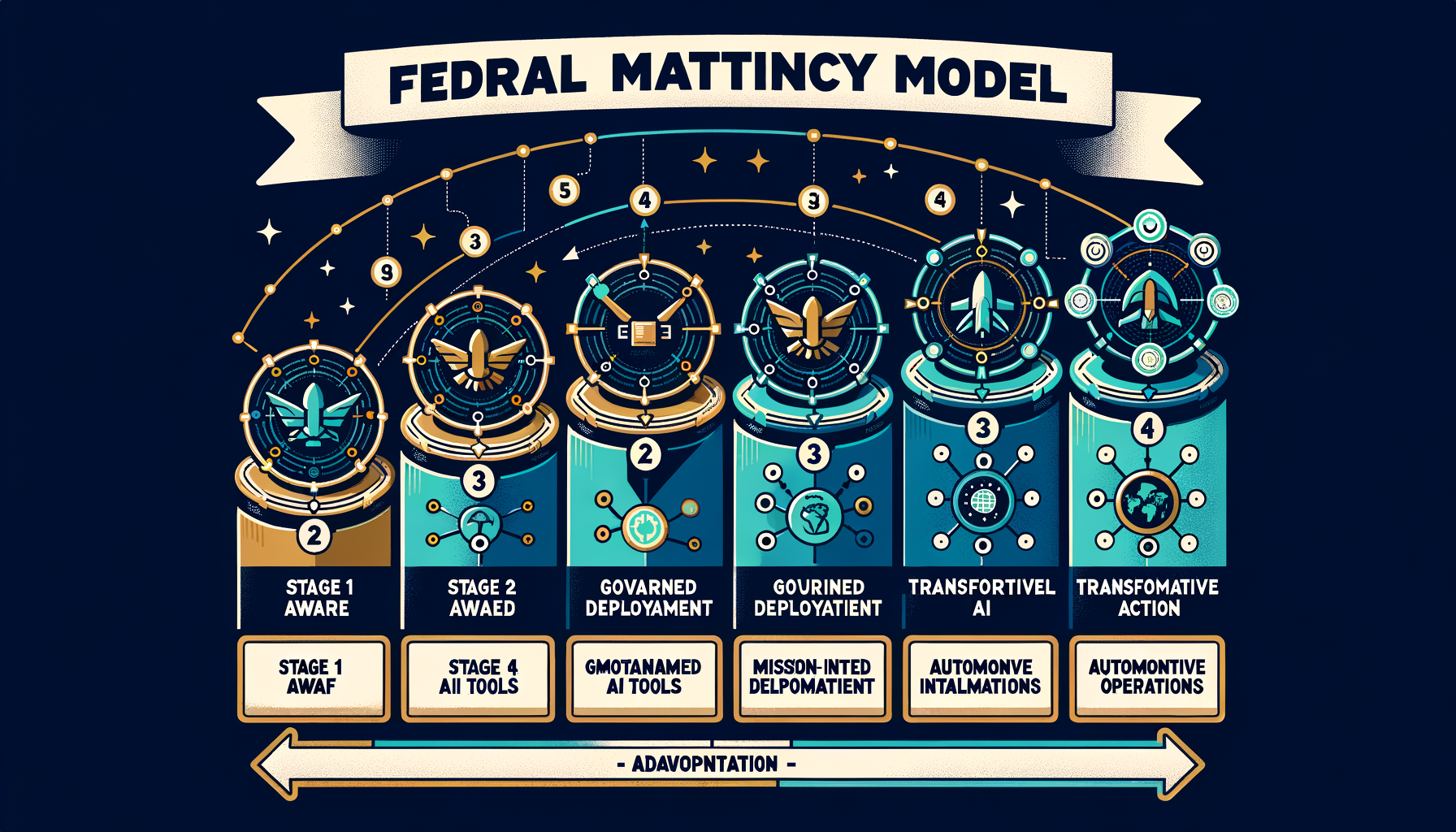
Six Capabilities Federal Agencies Need to Scale Agent Adoption in 2026
Most federal agencies have run at least one AI agent pilot by now. Many of those pilots succeeded on their own terms: the agent worked, users engaged with it, the use case was validated. What hasn't followed, consistently, is scale. The agent stays in the pilot environment, or it spreads to one team but not others, or it works until something changes in the underlying system and nobody knows how to fix it.
Microsoft's Copilot Studio team published a framework this year identifying six capabilities that separate organizations running successful isolated agents from organizations scaling agent adoption across their workforce. The framework is worth examining with a federal lens — because the structural barriers to scale in government are real, and the six capabilities map onto them directly.
1. The Ability for Anyone to Turn Intent Into Agents
Historically, building an agent meant translating a business requirement into technical specifications, then waiting for IT capacity. That bottleneck slowed adoption and concentrated agent-building in a small technical cohort.
The shift in 2025 was that natural language became the agent-building interface. In both Copilot Studio and the Agent Builder in M365 Copilot Chat, people can describe what they want done and create an agent to do it — no specialized coding required. IT retains governance over what's deployed; the creation surface is open to business users.
For federal agencies, this matters because mission subject matter expertise lives in program offices, not IT shops. The HR specialist who understands the leave request workflow, the contracting officer who knows the procurement edge cases, the logistics analyst who tracks the exception patterns — these are the people who can identify and define high-value agent use cases. Giving them a creation path that doesn't require a development queue changes the velocity of adoption.
2. Agents That Can Own Workflows End to End
Early agents were narrow: they answered questions, retrieved documents, or completed a single defined action. The 2026 capability threshold is agents that own a workflow from start to finish — receiving a trigger, completing multiple steps, handling exceptions, and producing a final output without human handoffs at each stage.
For federal agencies, this is the difference between an agent that summarizes a document and an agent that processes a form submission: validates inputs, routes to the appropriate reviewer, tracks status, generates a response, and archives the record. The first is useful. The second is transformative for agencies drowning in process-heavy work.
3. The Power to Coordinate Multiple Agents
Complex federal workflows often span systems, teams, and data domains. A single agent — however capable — cannot own a workflow that requires financial data from one system, HR records from another, and document management from a third. Multi-agent coordination is how that complexity gets addressed.
This capability is now generally available in Copilot Studio (as covered separately on this site). The practical question for agencies is not whether the technology exists but whether they have an integration and orchestration roadmap to use it. Agencies that have mapped their data sources, identified the handoff points between systems, and documented their workflow logic are positioned to benefit. Agencies that haven't done that foundation work will find multi-agent coordination premature.
4. Flexibility to Control Agent Models
Not every agent task calls for the same AI model. A document summarization task has different requirements than a complex reasoning task or a code generation task. Organizations that lock themselves into a single model for all agent workloads will find that some tasks perform poorly — and that performance gap becomes a credibility problem for the adoption program.
Copilot Studio supports model selection at the agent level. For federal agencies, the model selection question also has a compliance dimension: not all models available in commercial Copilot Studio are authorized for GCC or GCCH environments. Agencies need to understand which models are available in their tenant and ensure that agent deployments use only authorized models.
5. Agents That Can Act Across Systems
An agent that can only read data and generate text is limited in what it can automate. Agents that can take actions — updating records, sending notifications, triggering workflows, writing to systems of record — are the ones that generate measurable productivity impact.
The prerequisite is integration. Agents act across systems through connectors, APIs, and plugins. For federal agencies, the integration surface is often constrained: legacy systems without modern APIs, security controls that limit what external processes can write, and authorization requirements for system access. Mapping these constraints before scoping agent deployments prevents the gap between what's technically possible and what's actually deployable in your environment.
6. The Capability to Scale Without Sacrificing Control
This is where most federal agent programs stall. Individual agents can be governed through IT review and approval processes. When you have dozens or hundreds of agents operating across an organization, governance at that scale requires systematic controls — not manual review of each deployment.
The capabilities that support this include centralized admin visibility into what agents exist and what they're doing, policy-based controls on agent behavior, audit trails for agent actions, and lifecycle management for retiring or updating agents when underlying systems change. Copilot Studio provides these controls; agencies need to actively configure and use them rather than treating them as optional.
The Federal Reality Check
The six capabilities are a useful maturity map, but federal agencies should be clear-eyed about where the barriers are:
Legacy system integration is the most common limiting factor. Many high-value federal workflows run on systems that predate modern APIs. Connecting agents to those systems requires integration work that the AI platform itself doesn't solve.
Authorization and ATO timelines affect deployment velocity. Every new agent capability — particularly those that take actions in systems of record — may require authorization review. Agencies that have standing ATOs for Copilot Studio should clarify the scope of what's covered; agencies that don't should plan for that cycle.
Change management scales with agent scope. A single-team pilot requires minimal change management. An agency-wide agent deployment requires training, communication, governance documentation, and sustained leadership support. These are not technical problems — they're organizational ones.
The agencies that scale agent adoption in 2026 will be the ones that treat it as an organizational change program, not a technology deployment. The platform capabilities are available. The question is whether the organizational infrastructure is ready to use them.